News & Events
THE LIGHT: September 2024
Childhood and the Adversity of Trauma
How childhood trauma shape development
For a brief moment, close your eyes and picture the perfect childhood. Imagine wholesome food on the table. Warm hugs while saying good night. Family time filled with love and laughter. Honest conversations and healthy confrontation.
In this environment, a child’s connection to others is cultivated, a secure sense of self is nurtured, and the world feels safe.
Contrast this picture with a childhood that’s marred in adversity. Meals may be missed or nutrient-rich food isn’t readily available. Bedtime could look like falling asleep on a couch, in a car, or even on the streets. Caregivers are often depressed or stressed. Emotions within the family are oppositional, unpredictable, or volatile.
In this environment, developing trusted relationships is difficult, a sense of self is insecure, and a child’s world feels nothing short of scary.
Certainly, there’s no such thing as a perfect childhood. However, these two pictures paint a stark contrast. While manageable amounts of adversity in childhood are necessary for growth, problems arise when chronic adversity is coupled with minimal stability and support.
“Because children’s brains are still developing, trauma has a much more pervasive and long-range influence on their self-concept, on their ability to regulate themselves, and on their sense of the world,” shares Boston University Medical Center psychiatrist, Bessel van der Kolk, MD.
These negative coping mechanisms—like emotional withdrawal or extreme sensitivity—can aid survival in the short-term. However, they become increasingly counterproductive in the long-term.
“Jesus said, ‘Let the little children come to me, and do not hinder them, for the kingdom of heaven belongs to such as these.’” — Matthew 19:14
Understanding childhood trauma
The impact of complex trauma on a child’s developing brain
Childhood adversity and trauma are often confused, but they differ. Adversity includes experiences like homelessness, poverty, neglect, abuse, and exposure to violence, mental illness, or addiction. Trauma is the deep distress and inability to cope that results from these adversities, essentially the internal wound caused by them.
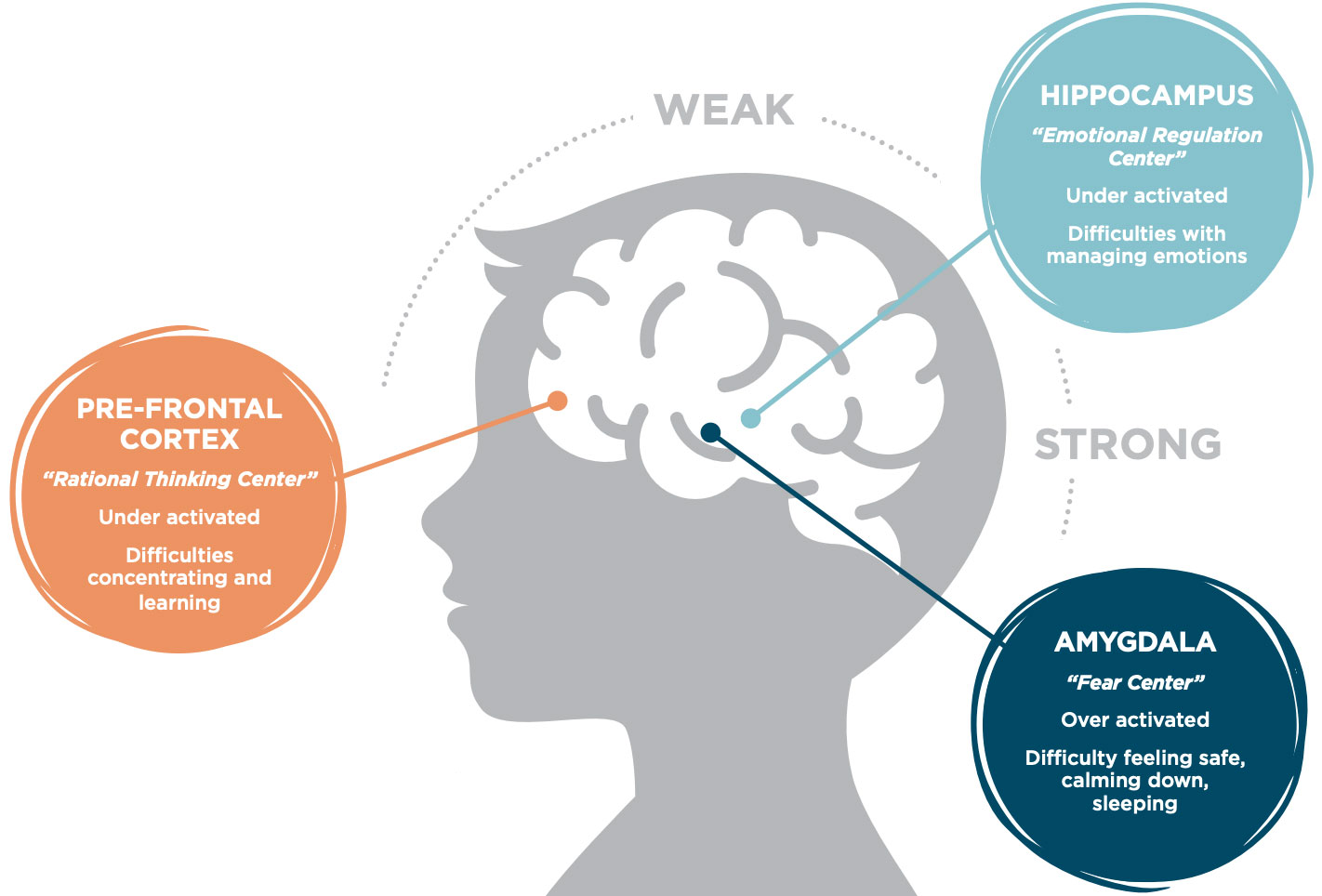
To understand how trauma alters the developing brain of a child, this graph shows the brain’s three core parts. In the traumatized brain, the amygdala is on high alert, while the pre-frontal cortex and hippocampus regions are weakened.
“Higher exposure to adverse life events is related to a reduction in brain volume in the regions important to executive functions such as reasoning, memory, emotional regulation, and perception,” explains Rajita’s Sinha, Ph.D., Professor of psychiatry and Director of the Yale Stress Center.
When trauma gets complex
Exposure to childhood adversity doesn’t always result in trauma or longterm negative impacts. Many children who experience adverse events in life return to normal levels of functioning with support from sensitive and responsive caregivers.
However, the majority of the children who come to Atlanta Mission are suffering from trauma’s negative outcomes. The reason why is because they’ve been exposed to multiple traumatic events over a long period of time. This is often referred to as complex trauma.
Long-term negative impacts
Changes to a child’s developing brain from trauma results in negative long-term impacts:
- Separation from self
- Disconnection from others
- Physical health
- Emotional pain
- Cognitive development
- Personal shame
- Difficulty thinking forward
The importance of trauma-informed care
What Atlanta Mission is doing to provide support to our children
Understanding trauma’s roots and long-term effects is key to providing comprehensive care. At Atlanta Mission, our trauma-informed approach supports children affected by trauma and works to prevent re-traumatization. When children arrive, they often feel fear and anxiety, making emotional regulation difficult. That’s why our facilities, My Sister’s House and Restoration House, implement trauma-informed care from the start.
Despite their trauma, these children have great potential. To help them heal, we focus on meeting their basic needs—providing nutritious meals, resilience-building activities, and supportive relationships with behavior coaches and social workers. Over time, fear and shame give way to courage and confidence, empowering them to overcome life’s challenges.
What learning looks like at Atlanta Mission
For kids who are bearing the burden of trauma, the anticipation of a new school year may feel more overwhelming than exciting. Our goal is to help children overcome the hardships of homelessness and trauma.
To meet this goal, we offer comprehensive care for kids from infancy through 12th grade. Trauma-informed services at Atlanta Mission include:
- High-quality childcare
- One-on-one tutoring
- Afterschool activities
- Enriching summer camps
- Counseling
- Social worker
- Behavior coach
Help a child build a future as bright and beautiful as they are
Every child deserves to grow up free from pain, poverty, and homelessness. But sadly, one in eight kids in our community experiences adverse events in our childhood. While trauma interferes with healthy brain development, the good news is that neural connections can rewire—with safety, stability, and loving support.
At Atlanta Mission, our team of professionals provide trauma-informed care to tackle childhood adversity at its roots.
Your gift today helps kids heal and changes the trajectory of their lives.